
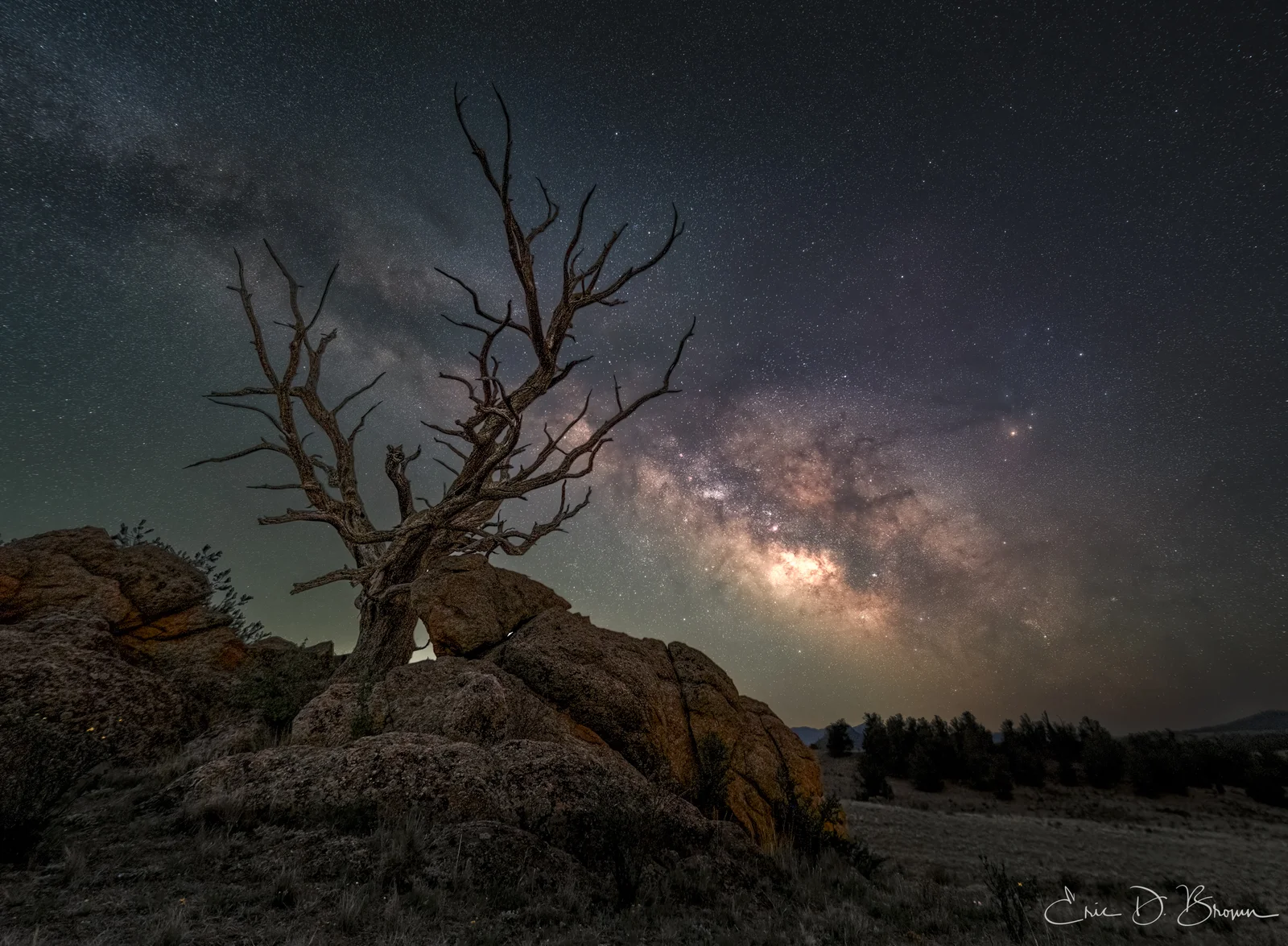
Roots and Stars
The tree stopped growing years ago. The stars haven't.
There's something satisfying about a shot that comes together from pure chance.
I was out scouting for Milky Way locations in Park County, Colorado. Had the timing mapped out and knew when the core would rise, knew the weather would hold. What I didn't have was a foreground worth shooting.
Then I found this tree.
Dead for years, maybe decades. Bare branches reaching upward like gnarled fingers. Roots wrapped around the rocks, holding on long after there was any reason to. I pulled over, got out, and walked around it. That was the foreground.
I came back that night. Arrived two hours before the core rose, set up my gear on the rocky outcrop, and waited. The temperature dropped. The stars emerged one by one, then by the thousands. And slowly, the galactic center climbed into frame, settling right behind that skeletal tree.
The foreground exposure took about two minutes. The sky was created from 15 stacked 13-second exposures to reduce noise.
People ask why I don't just composite whatever sky I want behind any foreground. The answer is simple: that's not what was there. The whole point is capturing what actually existed in that moment—light that traveled 26,000 years from the center of our galaxy, hitting my sensor at the same instant I stood on that hillside.
That's what makes it worth the cold hands and the late nights.
Related Photos
Visualize This Print in Your Home
Imagine how this stunning photograph would look hanging on your wall. Use the room preview below to get a better sense of scale and style. Ready to bring this piece into your space?
